|
This month the Journal of the Academy of Nutrition and Dietetics published an article: Use of the Plate by Plate Approach for Adolescents Undergoing Family-Based Treatment. Wendy Sterling, MS RD CSSD and Casey Crosby’s RD CDDS along side their colleagues Nan Shaw LCSW, and Susanne Martin, MD shared a step-by-step overview of the Plate method approach that can be used to communicate to parents during FBT treatment.
This approach builds on the premise that parents are the top resource and know how to feed their kids. RDNs need to speak the same language that the parents understand and not introduce new and more complicated systems. Parent advocate groups and FEAST-ED have used the term “Magic Plate” which can be described as “the planning, cooking and serving done without help or input from the patient whose only job is to arrive at the table and eat.” It intends to empower parents to use instincts and relieves the adolescent from anxiety to make decisions about food. Nutrition intervention for eating disorders can contain a variety of communication tools. Most RDNs agree that no one way work with all clients. Nutrition supports will flex based on our clients previous nutrition experiences, current level of care and treatment goals. (1) This nutrition “language” could take many forms: Exchanges, sample meal plans, plate method, or a blending of a number of approaches. No studies have validated one approach over the other. To get more information about this Plate by Plate approach grab a copy of Wendy and Casey’s new book. They provided a step-by-step overview of the Plate method to support parents as they feed their child to reverse the consequences of malnutrition and restore health. This unique method was adapted from the 2011 version MyPlate. 1) Lian B, Forsberg SE Fitzpatrick KK. Adolescent anorexia: Guiding Principles of the Dietetic support of Family-based Treatment. J Acad Nutr Diet Dec 2017.
1 Comment
Professionals who treat adolescents with eating disorders need to expect resistance, denial and caregivers with a limited understanding of the illness.
Resistance Young clients with eating disorders will present in your office with denial that there is a problem. Parents vocalize obvious signs and concerns including restrictive food patterns, weight loss and narrowing of food choices. The irrational food beliefs are often accompanied with related physical symptoms like stomachaches and cold intolerance and loss of menstrual periods in girls. It is very common to experience this resistance. Your patients will be resistance to talking in session, resistance to accepting recommendations and overall resistance to treatment and goals for nutrition. Denial Anosognosia means denial of illness. Clients who present with restrictive eating disorders do not believe they are sick and do not see their need for help. Professionals need to be prepared for this type of resistance and solicit the help of parents. Family-based treatment (FBT) utilizes the parents to help implement nutrition restoration, which helps to side step the resistance and denial that is present in the starved clients. Waiting for the young person to have insight and readiness to change may put them at risk for delaying treatment and contributing to chronicity. Parental Understanding Parents must become experts on eating disorders very quickly. Professionals should offer a number of resources and encourage outside reading. The faster the parents become educated consumers the greater the opportunity for progress and recovery. One new book just released should be a great supplement to any professional who treats eating disorders. This book written is by Lauren Muhlheim, PsyD When Your Teen Has an Eating Disorder: Practical Strategies to Help your Teen Recover from Anorexia, Bulimia & Binge Eating New Harbinger publications. There are ten chapters filled with step by step guidance, sample scenarios and practical tools that can be accessed on line as a supplement to the book.  Most RDNs are very familiar with how leavening agents work in baking. I would like to use this analogy to describe how writing and sending reports to your treatment team can leaven your professional community.
Definition Leaven: it’s an element that produces an altering or transforming influence. Dietitians who follow evidence-based approaches when treating adolescents with eating disorders and use documentation effectively will produce a transforming influence in their community. Your community includes: physicians, nurse practitioners, pediatricians, therapist, and psychiatrist. Documentation will leaven your community and spread a clear understanding about eating disorders and family-based treatment (FBT). As clearly stated in the newly revised The CEDRD in Eating Disorder Care booklet: “RDs often act as case managers in the outpatient setting as medical practitioners and psychologists increasingly find they do not have time to do this critical aspect of care. Case management involves making sure that all members of the outpatient team have frequent communication and agree to treatment details.” Your treatment team will be transformed in a number of ways:
I have been an RDN for too many years to mention. Actually, I learned the ADIME (Assessment, Diagnosis, Impression, Monitoring and Evaluation) documentation system from my interns and students. I felt that the use of a PES (problem, etiology symptoms) statement was a wonderful way to articulate a clear picture of the patient. I always add my impression and expand my PES statement to allow for more understanding and education. Documentation will leaven your community and spread a clear understanding about eating disorders and family-based treatment (FBT). It starts with sending that fax and then established the best way to communicate after that. If you are interested in sharing a sample of the documentation that I use please contact me today. Professionals who use the FBT approach to treat adolescents with eating disorders can utilize this stance in the first session. Experts in eating disorders identify the life-threatening symptoms and express alarm and compassion at the same time. Both sides of the coin are needed to orchestrate an intense scene. This is referred to as a therapeutic bind. The goal of this technique is to engage the family. Each family comes to the initial session with a unique level of confidence, anxiousness and understanding of illness. During the assessment the therapeutic bind can either propel paralyzed parents into action or ground overly anxious parents to get them focused on their role in weight restoration. RDNs use this therapeutic window to move parents into action with acceptance and commitment to the role of feeding. This happens when professionals use the facts (collect these on the EDGE tool prior to the meeting) and their expertise in eating disorders to communicate. RDNs are uniquely qualified to make the connection with the physical symptoms of the body and educate how malnutrition has caused a series of physical problems. The “Food Is Medicine” message can be heard more clearly when parents have experienced this intense scene. 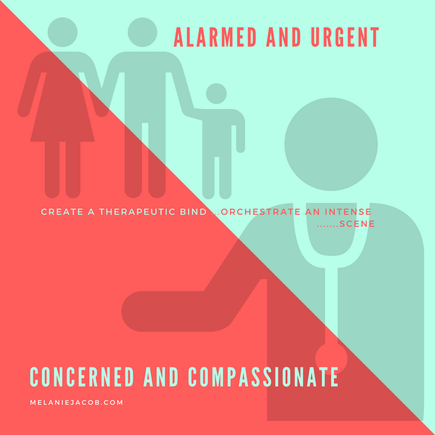 One example of this is when I had a young lady in my office with her mom. She was clearly in need of hospitalization. I educated the parent on the facts with a tone of urgency and alarm. I expressed my concerns over her daughter’s heart rate and rate of weight loss and risk of refeeding syndrome. We talked about the need for a medical visit the next day and prepared the Mom to consider how she could ask her employer for Family Medical Leave Act (FMLA). Direct, urgent, honest and caring words helped the mother who was in tears know what to expect. Today her daughter is a doing well in high school. Without the FBT approach she still may be fighting a chronic eating disorder.
Learn more about how to blend urgency with compassion. If you treat adolescent with Eating disorders learn how to blend FBT informed treatment and sign up for coaching with Melanie Jacob, RDN today. Save your spot for the fall webinar series here. FOUR: Paradigm Shift is long over due in Eating Disorder Treatment
I love to read scientific articles and attend conferences like ICED to learn about the latest research in the eating disorders field. This article by Stuart Murray spoke to the need to look beyond weight as an indicator for recovery. We should never assume that weight-based recovery is a proxy for broader cognitive recovery. This is not supported by evidence. This has been a motivation for me in my clinical work in the development of the Eating Disorder Global Evaluation (EDGE). I strongly recommend the use of symptom assessment in both the physiological and behavioral realms. The EDGE is not yet validated and should be used along with the EDEQ. The EDGE instrument allows clinicians within 5 minutes to identify symptoms. I recommend that it is used this at baseline and every three months during treatment. The beauty of the form is that noting frequency can score symptoms: daily, weekly or in the last month. These scores typically reduces with nutritional restoration and time in treatment. Often residual behavioral symptoms are targeted during phase 2 and 3. Since anorexia nervosa is ego syntonic and our clients could be very young; providers can utilize dual or parent-report observations of symptoms. Why use the EDGE instrument in your practice? THREE: Know and Practice your FBT Assumptions
RDNs who interact with parents, professionals and clients need to operate and communicate with five key FBT assumptions. It is vital that professionals remain consistent with what we say in our counseling sessions and in our written communication to the treatment team. 1. Do not focus on the why (Agnostic view of causation). “Instead of focusing on why this happened; can we use our time to focus on solutions?“ “You did not cause this illness.” “It was a perfect storm.” Maintain a “no-blame” stance. Guilt leads to immobilization. Empower parents and help families see their strengths or enhance their skills. Join with family and collaborate to combat the eating disorder. Eating disorders are genetically influenced by personality traits and cognitive patterns that reveal core biological risks factors. Direct to resources on neurobiology, genetics, and the Ancel Keys research. 2. Externalize the eating disorders. “Your child/adolescent/teen has been hijacked by ED and she is under the influence.” “If your child had cancer you would insist they takes their medicine.” “Food in the medicine for malnutrition.” The eating disorder is viewed as separate from the child or as an outside entity (like the diseases model in which the disease is not seen as the person). The eating disorder is the problem not your child. 3, Parents are experts on their child. RDNs serve as consultants. “You know how to feed your child.” “Your commitment to their recovery is key to their success.” “You have successfully fed your older/other children with success.” “Would you be interested in nutrition resources?” “How can I be of help?” RDNs who offer parent coaching; referred to as parent intensive counseling (PIC) or Parent Assisted Meals and Snacks (PAMS). Encourage re-integration of previously consumed foods and caloric density. Offer support with food planning as needed. This is done in a non-authoritative way. 4. Empower Parents and caregivers. “You are doing a great job with….” “Your child’s health and nutrition must come first.” “If I were to write a check at the end of the month for the work you are doing for your child it would be over $?0,000 dollars.” RDNs may feel more comfortable with a direct approach in nutritional counseling. We need to pivot to offer coaching and empowerment. We can address nutritional beliefs that are barriers to recovery. We can support parental empowerment and build confidence through competence. Assist parents in understanding how current food practices affect weight progress. 5. Initial focus is on weight restoration & symptom management. “From the EDGE results I am concerned for your child’s health.” “I am seeing some red flags (physical symptoms) and without an increase in food and nutrition we may need a higher level of care.” “Everything stops until they eat.” Use the shock of the parents to create a therapeutic bind to create energy, urgency and momentum for nutritional rehabilitation. Provide a simple explanation on metabolism to help parents and possibly the mature teen to understand the consequences of poor energy balance and what symptoms reveal. Validate progress as you see symptoms improve with weight restoration and adequate nutrition. For more information on how the RDN can implement FBT informed treatment. Save your spot for the fall webinar series by Melanie RDN need to be prepared to strengthen the team that is not FBT informed or trained. In rural communities RDNs may find themselves as the most seasoned expert in adolescent nutrition and eating disorders. This work is not for the faint of heart. Build relationships and use documentation as way to educate and train others on the approach. Build a team that works in concert to bring about the best results and resist splitting due to misunderstandings or miscommunication. TWO: Instill a unified approach and communication style with medical providers, therapists and parents.
2. Provide websites and reference to help the team understand the phases of treatment. 3. Share this article with MD's and pediatricians. 4. Strengthen yourself by getting supervision, training and mentoring.
Family-based treatment (FBT) originated without Registered Dietitian Nutritionist (RDNs). Many RDNs are now finding themselves either being asked to contribute to a treatment team who uses FBT or are interested in launching the FBT principles in their work with adolescents who have eating disorders. It makes sense to me to follow the only evidence-based treatment for adolescence with eating disorders. My hope is to share my wisdom gleaned over the nearly 10 years working with a collaborative team in an outpatient setting. RDNs are well positioned to coach parents in the vital task of in-home re-feeding. Here is my top 10 things to know, use and expect... One at a time. ONE: Identify potential team members Be prepared to sell yourself and educate the team on what you can do as an RDN. This may take face to face meetings and networking.
- Discuss who will discuss and make exercise recommendations. - Review protocols for checking clients who are at medical risk. - Agree on treatment weight goals.
- Do you have their cells phones, emails and fax numbers?
- Know your residential or IOP options - Suggest discharge meal planning happen directly with the parents not child or adolescent. if I think back to why I originally became a registered dietitian it was because I knew that this career would allow me to spend time with my family and work. In 2015 everything came to a halt with my busy private practice Nutrition Therapy in Troy Michigan. My husband who works for Ford Motor Company was asked to take an assignment and Chongqing, China.
It has truly been a life changing adventure! I have a new perspective. I understand food In the context of the culture you live in I see the world a bit differently. As my sabbatical has officially ended. I am at a crossroads. I am asking myself how can I best use all my talents, abilities and expertise in eating disorders and yet keep this beautiful balance the “sweet spot” of caring for your children. The children who grow up so fast. |
AuthorMelanie Jacob RDN is a seasoned eating disorder professional that found her niche in treating adolescents with eating disorders. When the FBT research surfaced in 2006 she transitioned her approach to follow the evidence. Archives
September 2018
Categories
All
|
 RSS Feed